
Cybersecurity has gotten... strange.
It used to be that cybercriminals had to find vulnerabilities in your network or exploit outdated software. Today, many attackers simply convince someone inside your organization to do the work for them.
Politely.
Meet Karen.
Karen works in accounting.
She wasn't trying to compromise the company network. She wasn't downloading suspicious software. She certainly wasn't planning to become the topic of next week's cybersecurity meeting.
Karen was just trying to find tacos.
Around lunchtime, she searched for a local restaurant and clicked a website. A familiar message appeared: "Verify you are human."
Seems harmless enough.
Karen is very much human. The kind of person who notices a $0.17 discrepancy in a spreadsheet before anyone else does.
So she clicked.
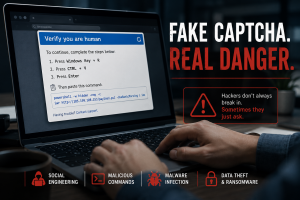
But instead of asking her to identify traffic lights or crosswalks, this CAPTCHA displayed a different set of instructions:
- Press these keys.
- Paste this command.
- Run it.
That should have seemed unusual.
The problem is, technology asks us to do unusual things every day.
Accept cookies.
Approve the login.
Enter the verification code.
Restart your computer.
Install the update.
Restart again because apparently the first restart wasn't enough.
We've all become conditioned to follow prompts without questioning them.
Karen simply assumed technology was being... technology.
Unfortunately, this wasn't a security check.
It was malware.
What Is a Fake CAPTCHA Attack?
A Fake CAPTCHA attack, often called a ClickFix attack, is a growing form of social engineering that tricks users into running malicious commands on their own computers.
Instead of simply verifying you're not a bot, these fake CAPTCHA screens instruct users to:
- Copy and paste commands
- Open Command Prompt or PowerShell
- Run scripts
- Install software
- Disable security protections
Once completed, attackers can install malware without exploiting a traditional software vulnerability.
Within minutes, they may attempt to:
- Steal passwords
- Hijack browser sessions
- Access Microsoft 365 accounts
- Read company email
- Encrypt files with ransomware
- Move throughout your network
- Access financial or customer data
This attack doesn't exploit technology.
It exploits trust.
Why Fake CAPTCHA Scams Are So Effective
The important lesson isn't that Karen "should have known better."
Modern cyberattacks are intentionally designed to look ordinary.
Employees regularly encounter:
- Microsoft sign-in prompts
- Shared document requests
- Vendor emails
- QR codes
- Browser warnings
- CAPTCHA verification screens
Attackers know that familiarity lowers suspicion.
When everything looks legitimate, people naturally assume it's safe.
That's exactly what makes fake CAPTCHA attacks so dangerous.
Warning Signs of a Fake CAPTCHA
A legitimate CAPTCHA should only verify that you're a real person.
It should never ask you to perform administrative tasks on your own computer.
A Real CAPTCHA Will Never Ask You To:
- Open Command Prompt
- Open PowerShell
- Copy and paste commands
- Run scripts
- Install software
- Disable antivirus or security tools
- Change Windows settings
If a website asks you to do any of these things to "prove you're human," stop immediately and contact your IT team.
You're not verifying your identity.
You're being socially engineered.
How Businesses Can Protect Against ClickFix Attacks
Technology alone isn't enough to stop today's cyber threats.
Organizations need a layered approach that combines security tools with employee awareness.
Best Practices Include:
- Provide ongoing cybersecurity awareness training.
- Teach employees what legitimate CAPTCHA prompts look like.
- Restrict unnecessary administrative privileges.
- Deploy endpoint detection and response (EDR) solutions.
- Enable multi-factor authentication (MFA).
- Encourage employees to report anything unusual without fear of blame.
The sooner an employee reports a suspicious prompt, the smaller the potential impact.
Cybersecurity Is About People, Not Just Technology
Security software blocks many attacks.
But increasingly, cybercriminals are targeting people instead of firewalls.
That's why the strongest cybersecurity strategies combine:
- Modern security technology
- Well-trained employees
- Clear security policies
- A culture that encourages asking questions
At CKT, we believe technology works best when it becomes common knowledge.
Because cybersecurity isn't just about preventing attacks.
It's about helping people recognize when something doesn't feel right.
Final Thoughts
Karen didn't intentionally compromise the business.
She simply encountered an attack designed to look routine.
She also never got those tacos, which may have been the greatest tragedy of the day.
Her company did, however, establish one simple rule: Never let a website tell you how to operate your own computer.
That's not verification.
That's an attacker hoping you'll do their job for them.
Keep Your Team One Step Ahead of Modern Cyber Threats
Fake CAPTCHA attacks and ClickFix scams are becoming increasingly common because they target people, not technology.
The good news? A little awareness goes a long way.
At CKT, we help organizations build a culture of cybersecurity through the right technology, employee training, and practical security strategies that keep businesses protected.
Think your employees would recognize a fake CAPTCHA attack? Let's find out. Contact CKT today to turn cybersecurity from confusing into common knowledge.

