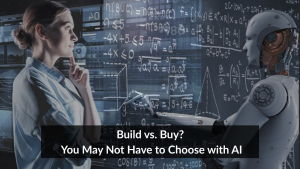
Businesses today face a familiar dilemma: should you build AI solutions in-house or buy prebuilt tools from vendors? Both paths have unique benefits and challenges, but the reality is, you don’t always have to choose one over the other. By taking a hybrid approach, organizations can leverage the speed and reliability of prebuilt AI while customizing the components that differentiate their business.
This edition dives deep into the considerations, strategies, and best practices for making AI work for your organization, without compromising security, data governance, or innovation.
The Build Option: Custom AI Solutions
Building AI in-house offers full control over functionality, integration, and sensitive data. Custom AI lets you tailor models to your exact business needs, making it easier to create unique capabilities that competitors can’t easily replicate.
Key Benefits of Building AI:
- Complete Customization: Design AI models to address unique business processes and challenges.
- Data Privacy & Security: Keep sensitive business and customer data under your direct control.
- Long-Term Flexibility: Adjust and refine models as your business evolves.
Challenges:
- High upfront investment in talent, infrastructure, and time.
- Continuous maintenance and retraining of models.
- Need for strong internal governance to ensure ethical and compliant AI use.
The Buy Option: Prebuilt AI Tools
Prebuilt AI solutions offer speed, reliability, and scalability. Vendors provide models and platforms that are ready to integrate, often with ongoing updates, security monitoring, and regulatory compliance baked in.
Advantages of Buying AI:
- Rapid deployment with minimal development time.
- Lower upfront costs compared to building in-house.
- Access to vendor support, updates, and pre-trained models.
Considerations:
- Limited customization for specific business needs.
- Vendor lock-in and dependency on external updates.
- Data privacy may be a concern depending on vendor policies.
Hybrid Approach: Best of Both Worlds
Hybrid AI strategies combine prebuilt tools for standard tasks with custom models for business-critical differentiators. For example, a company could use off-the-shelf natural language processing (NLP) models for general text analysis but develop proprietary models for highly specialized customer insights.
Benefits of a Hybrid Approach:
- Faster Deployment: Prebuilt components accelerate time-to-value.
- Cost Efficiency: Build only what’s necessary; leverage vendor tools for standard needs.
- Governance & Security: Maintain control over sensitive data while benefiting from vendor expertise.
- Innovation: Focus internal AI development on high-impact, differentiating features.
Best Practices for Hybrid AI:
- Implement strong data governance frameworks to manage both internal and vendor data effectively. Following AI Data Governance Best Practices ensures your hybrid strategy maintains quality and compliance.
- Maintain robust security measures for both custom and vendor-managed components, as detailed in How Data Governance & AI Drive Compliance and Security.
- Establish transparent AI policies to build stakeholder trust and accountability, aligning with recommendations from AI Governance as the Cornerstone of Trust.
Learn how hybrid AI can accelerate innovation safely

